
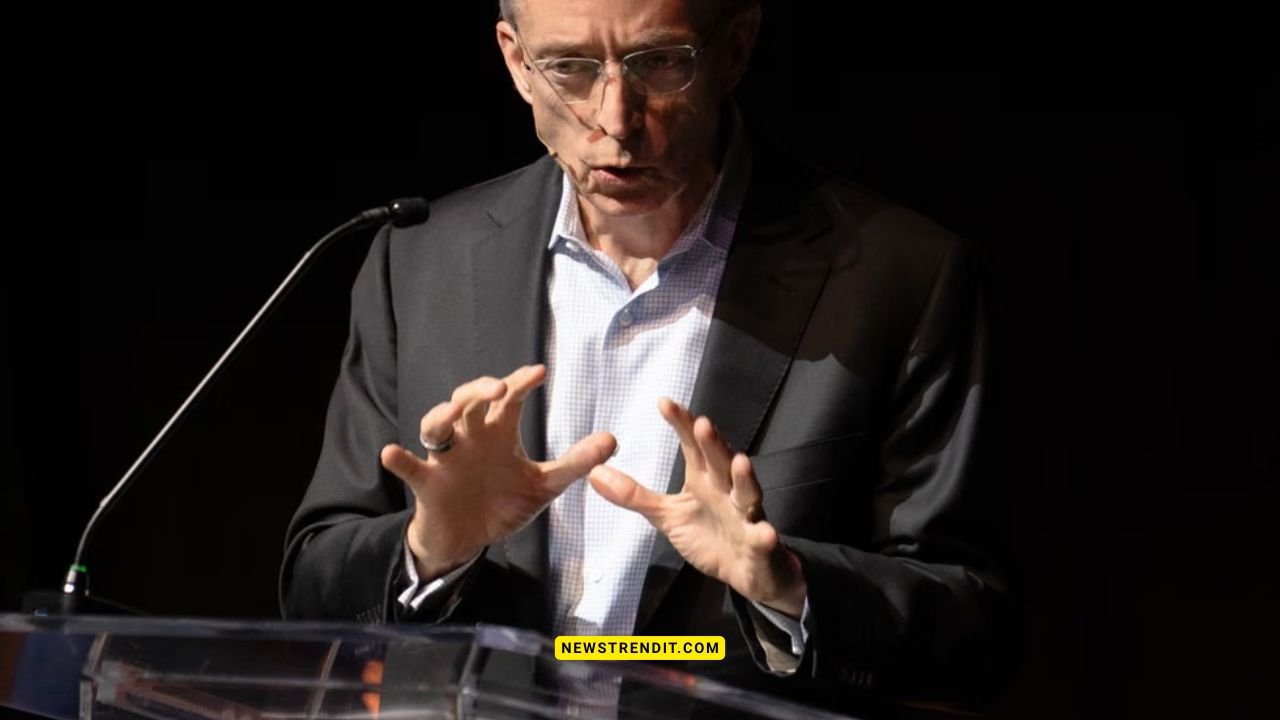
From Intel to Gloo. The goal of the former CEO of Intel was to “Hasten the Return of Christ” by creating a Christian AI. As the current Executive Chairman of Gloo, Patrick Gelsinger has dedicated his life to introducing Christian principles into the artificial intelligence industry and Silicon Valley.
Gelsinger took over Gloo, a digital startup geared at what he refers to as the “faith ecosystem,” just three months after resigning as CEO of Intel and being sued by shareholders. Think of it as a Salesforce for churches, providing digital tools, chatbots, and AI assistants to automate pastoral care and ministry tasks.
The timing of this career change coincides with the U.S. tech industry’s renewed involvement in politics and religion, which is becoming a major source of financing and influence. Donald Trump’s reelection campaign is currently receiving support from certain prominent industry players who are siding with a new wave of Christian conservatives in Washington, D.C.
Gelsinger, who is mostly exempt from the shareholder lawsuit as Executive Chairman and Chief of Technology of Gloo, has made it his mission to advance Christian-centered technology. He hopes to disseminate the company’s faith-based values throughout Silicon Valley, Capitol Hill, and beyond with a $110 million financial base. He wants to create AI that embodies Christian moral and ethical principles, not just create AI.
From Intel to Gloo
“Creating technology that enhances human life and speeds up Christ’s return has always been my life’s mission,” Gelsinger stated.
More than 140,000 nonprofit, ministry, and faith-based leaders are reportedly served by Gloo. Gloo’s objective is distinct—it combines faith and technology—even though this is a small portion of the user base of industry titans like ChatGPT, who have almost 800 million weekly users.
Silicon Valley: Where Faith and Technology Collide
As a self-described “born-again Christian,” Gelsinger frequently refers to Silicon Valley as his “mission field.” Atheism used to rule the area, but now “a visible, distinctly Christian-tinged tech culture” is emerging, according to Damien Williams, a researcher at the University of North Carolina.
People like Katherine Boyle of Andreessen Horowitz, a close associate of U.S. Vice President JD Vance, and Peter Thiel, who warns of a “antichrist” if mankind veers away from technology advancement, reflect this change.
In an effort to ignite a Christian spiritual renaissance in the San Francisco Bay Area, Gelsinger co-founded Transforming the Bay With Christ in 2013.
“Our Next Gutenberg Moment Is AI”
At a symposium organized by Gloo, Colorado Christian University, and The Christian Post on October 7, Gelsinger called artificial intelligence (AI) “another Gutenberg moment”—a revolution as significant as the Reformation.
He drew comparisons between Martin Luther and the printing press, stating that the Church now has an opportunity with AI that is akin to how Luther exploited technology to spur human advancement.
“In order to change humanity, the Church once embraced the greatest invention of its time,” he added. The question now is: Will we accept and mold AI as a continuation of the Church’s mission?
“Jesus’s Hackathon”: Combining Creativity, Code, and Faith
Gloo is actively creating a Christian tech ecosystem in order to fulfill its objective, which goes beyond simply discussing AI. Following the seminar, the firm held a three-day hackathon at Colorado Christian University, drawing over 600 participants—nearly three times as many as the year before—who competed for $250,000 in prizes.
But there were problems with the event. Ryan Siebert, an AI developer, found that a prompt injection may be used to control Gloo’s new huge language model, which is currently in pre-beta, to create illicit content. He informed Gloo’s leadership immediately about the vulnerability, and they verified that the hackathon was intended to stress-test and enhance the model.
Creating Political and Religious Bridges
According to Gelsinger, his message of “Christian AI” is becoming more popular in Washington, D.C. He said in an interview that he has shown Gloo’s work to congressional officials and legal organizations, some of whom expressed interest in implementing Gloo’s technology in their own churches.
Gloo frequently travels with conservative people. Annie Chestnut Tutor from the Heritage Foundation and Brandon Showalter, a journalist for the Christian Post with a reputation for being anti-transgender, spoke at the same session about AI regulation from a conservative policy perspective.
At Liberty University’s CEO Summit on October 17, Gelsinger gave his “Gutenberg Moment” speech alongside Liz Truss, Michael Flynn, and Dan T. Cathy, CEO of Chick-fil-A.
Despite this alliance, Gelsinger has maintained a bipartisan stance by supporting both Republican and Democratic campaigns, according to public records.
Gloo’s Vision: An All-Faiths Platform
Gloo stays away from theological or political divides. The hackathon organizers urged everyone to “stay focused on Jesus” rather than politics when one participant suggested building an AI bot based on conservative activist Charlie Kirk.
A female pastor was among the participants, who came from a variety of backgrounds. Many said the environment was welcoming and collaborative.
Participant Leah Brooks, whose team developed open-source AI technologies linking faith-based apps, stated, “We didn’t even have to sign a statement of faith.”
Gloo even permits the usage of their technologies by Muslim organizations.
Gelsinger stated, “We’re not promoting a single theological viewpoint.” We’re creating a platform that can accommodate Lutherans, Catholics, Episcopalians, and other faiths. It has to do with human flourishing and faith.
“Flourishing AI”: Technology’s Fundamental Faith
Additionally, Gelsinger is in charge of Gloo’s Flourishing AI project, which evaluates huge language models’ effects on human well-being in seven domains, including faith. It assesses whether AI systems foster moral and spiritual development, drawing inspiration from Harvard’s Human Flourishing Program.
Gloo reports that models such as Grok 3, DeepSeek-R1, and GPT-4.1 receive an average score of 81/100 when it comes to fixing financial problems, but just 35/100 when it comes to helping customers with their spiritual lives.
Gloo claims it has begun interacting with significant AI firms, despite Silicon Valley’s lack of interest thus far.
Gelsinger said, “I want Zuck to care,” referencing to Mark Zuckerberg, the CEO of Meta.
Gelsinger’s fundamental goal is to make sure that faith influences AI’s future while AI changes humanity’s.